11.11.09

Here's an expanded version of the great conversation I had with Willamette Week's Kate Williams a few weeks ago. There's also a link to Kickstarter's blog, which now features
The Ethical Butcher!

Excerpt from 'Sea Salted' blog November 8, 2009
http://sea-salted.blogspot.com/2009/11/meat-beat.html

I recently got to write up a short piece for WW on a couple of up-and-coming butchers in the Portland area. Both are making their names for themselves with a badge of sustainability, and both have given me a lot of food (heh) for thought surrounding this issue.

The younger of the two, Berlin Reed, came back out to Portland at the end of the summer after spending a stint working in the Brooklyn (NY) food scene. Most recently, he held the post of butcher at Greene Grape Provisions, a store that seems to be doing a lot right. He basically taught himself how to cut up animals, how to cure bacon (including lamb! bacon! yes!) and how to source the most ethical meat possible. Best part about Berlin, though, is that he used to be a vegan. Militantly. He was so vegan that he wouldn’t even sit next to, let alone have a legitimate conversation with, meat eaters. For him, it had always been an ethics issue. He knew about the horrors of industrial meat production and wanted nothing to do with it.

Once he found good meat, though, his veganism was gonners. His first bite of flesh in 14 years was rib-eye, and he hasn’t looked back. In the last year, he has penned himself The Ethical Butcher, writing a blog, networking with farmers, making insane bacon* and being an advocate for sustainable omnivorism. But all of this is in my story. You should read it.

The part of his story that got left out of editing, and what really got me thinking, was his derision of pescatarians. I know a lot of pescatarians. In fact, most of my vegetarian friends eat fish regularly. I’ve always been a bit confused by that choice, but I never understood why I couldn’t accept it as reasonable. After Berlin and I got to talking, I remembered some images I had seen of shrimp farms in god-knows-where Asia and thought, those look just like the shots of Tyson chicken farms that made me so ill. And then Berlin brought up migration patterns and worldwide oceanic ecosystems and dwindling populations and shipping and … oh yeah, fish and other seafood are just as unsustainable as meat. There just aren’t evil corporations like Tyson for us to shake our fists at. Sure, there is sustainable seafood out there. Programs like the Monterey Bay Seafood Watch do a great job listing safe products, and even give you a really easy color-coded system to check on tomorrow’s future dinner.

Yes, it’s tricky to keep up with fish sustainability. Today’s green light will be tomorrow’s red flag, but really, if you think about it, it’s not that much harder than remembering peaches are not seasonal in December or that there are no winter squash in July. Some seafood (farmed shrimp) will never be sustainable to eat, just like New Zealand kiwis will never lose their giant carbon footprint. So pay attention. If you do choose to eat only fish, do it with the same responsibility you attribute to avoiding meat. Think local. Think seasonal.

Kickstarter Blog November 10, 2009

Creator Q&A: The Ethical Butcher
Posted by cassiem

We’ve heard it a million times before (thanks, Mom) - “You are what you eat.” But whatare we eating these days? Good thing we’ve got folks like Berlin Reed, better known as The Ethical Butcher, around to help us answer that question. Berlin’s butcher company, which specializes in the humane slaughtering of sustainably farmed animals, aims to educate customers on ethical eating choices while offering them bacon cured in everything from watermelon to whiskey. “I enjoy empowering people to make better choices about their food,” Berlin tells us. “I think people are intimidated by so much of the local/organic/sustainable movement. I try to put it into perspective…The info is out there and all you have to do is make a choice.”

Having recently relocated from Brooklyn to Portland, Oregon, Berlin is aiming to take up the cause on the West Coast. He hopes to bring The Ethical Butcher to Portland’s Farmer’s Market by March 2010, and he’s using Kickstarter to do it.

Read what else Berlin had to tell us below. Support his project here.

So you went from militant vegan to butcher - what happened? I’m very curious!

I had been vegetarian since my early teens, I was 26 when I started eating meat again. My vegan days were about 3 years of that time from 19-22 or so. I have always been very interested and passionate about food but I actually worked as an EMT back in those days. I loved cooking, especially trying to make delicious healthy vegetarian foods and I finally started working in food when I moved to NYC in 2007. I first worked in a wine store and fell in love with it my first day. I knew I wanted to make a career in the food world. At that point I was still dedicated to my vegetarianism, so I wanted to gain expertise in a field where that wouldn’t be challenged. I went from the wine store to working as a cheesemonger then cooking and bartending. For a while I even wanted to go to Germany to study to be a Brewmaster. I took the job as a butcher mostly out of necessity. I thought I was interviewing for a cheesemonger position at a new gourmet shop in Brooklyn, after hiring me they told me it would be a couple months before the current monger left and asked if I’d be willing to help out the meat and fish guys. I was hesitant, but needed work so I accepted with full intentions of returning to cheese. A couple months went by and it turned out the guy wasn’t going to leave, which was perfect because by then I had fallen in love with butchery and didn’t want to go back to cheese. While there is definitely a place for vegetarian/vegan/raw chefs in the culinary world, I have always been drawn by the traditional. And what is traditional is milk, eggs, butter, meat, real foods. Working with meat felt right and good and honest.

I was still abstaining from meat about 2 weeks into working there, everyday I wondered to myself if I was ready to start eating meat. All along my major objections to eating meat were related to consumerism and animal rights, specifically I did not wanted to financially support companies that were profiting from the abuse of animals. I never had a problem with the fact that animals are sometimes food. Now that I was the one purchasing the meat, cutting it down and knew exactly were it was coming from, I had no reason not to take a bite. I also felt like not eating meat was holding me back. It is difficult to explain how to cook a London broil, what cut to use for stew or the best steak for a given cooking method if you have not tasted and cooked them yourself. My mentor butcher, Bryan Mayer had a lot to do with it too. He picked up butchery a few months before I did. The two of us just dove in, we were both bitten by the bug and wanted to fill our heads. We are both so dedicated to this work. We actually used to sit over our whiskeys after cutting all day and lament the demise of the oceans due to bad fisheries and the scarcity of truly sustainable beef. A strange conversation to overhear at the bar, I’m sure.

I always say butchery is everything I have ever loved in my life combined into one. It is hard, bloody, physical work based on biology and anatomy that brings about something that is at once aesthetically pleasing, delicious and steeped in history. I found a writer within myself because of butchery. This craft allows me to be political and artistic as well as grounded and connected to my food and my community. I honestly feel this is my destiny. I am the grandson of Alabama hog farmers raised by his German grandmother, what else am I supposed to do?

Talk to me about your cause - why is being an ethical butcher important? How do you convey this to your patrons?

Having ethics and integrity is so important these days when it comes to food sustainability. I think it is the duty of butchers, fishmongers and chefs to start making the difficult choices that consumers can’t or won’t make for themselves. I don’t mean to say people can’t choose what foods they want to eat. Far from it, I do think that we can do better to make sure that all the food choices offered are good choices for consumers AND the environment. I get so upset when I walk around these natural food stores. They implement a color-coding system for fish species- which is exactly what all the reputable fishery guides do, but then they carry “red” choices. That totally defeats the purpose. Your customer may love an item and won’t think much because they are only buying a half pound, but you have to buy 25 lbs to keep it in stock. As a purveyor, we are the ones with the responsibility, the knowledge and buying power to change things. We are also in a position to educate the public about the issues. I enjoy empowering people to make better choices about their food. I think people are intimidated by so much of the local/organic/sustainable movement. I try to put it into perspective. It doesn’t have to be this elitist, expensive venture. The info is out there and all you have to do is make a choice.

You’re working to change the way the meat industry handles its product - what’s your ideal vision?

I think sustainable butchers are going to save the world. My ideal vision is one where butchers and fishmongers are back in the neighborhoods using products from local farms, rivers and lakes as well as responsible fish farms. Where people have a true alternative to cheap diseased meat wrapped in plastic and styrofoam that comes from a hidden room at the back of the supermarket. I loved the relationships I had with our customers in my shop in Brooklyn. They could place special orders, get dinner advice and watch me work feet away from them. I also dream of a public that is knowledgeable and aware of the impact of their choices. I also really want to start a butchery school as well as some sort of international association of like-minded butchers, fishmongers and chefs, with conferences and the whole nine. When people realize that wild salmon populations are more important than the lox on your bagel in February, or that 100% grass-fed beef meansseasonal beef. I want to see heritage breeds return to the market on a large scale and the manufactured breeds created for speed of growth to fall by the wayside. I stop short of calling myself a Luddite, but I am strongly for a return to the way things were. I often think about how, years ago, people thought they were using technology to help future generations by switching to industrial farming methods, trawling the sea floor for bottom-fish or farm-raising fish in open rivers. And now here we are, cool kids getting famous because we make food with our hands. Bakers, butchers, cheesemakers, farmers, we all just want to get it back.

How have people been responding to your use of Kickstarter?

The response to my Kickstarter has been awesome!! My girlfriend actually turned me on to it and I thank her for it every day! It has been an incredible marketing tool and is definitely the only way I will be able to get my business off the ground soon. I know that I am on to something, as far as I know, no one is making bacon like this and especially with sustainability as the standard. With just having moved from NYC to Portland, I am still getting back on my feet. There have been times recently when I have only had 10 bucks to last me a week. I was getting so frustrated with people telling me I was going make millions that I decided to just get going on it in any way I can.


As of this posting, 28 backers have pledged $1,255!! With 50 days to go, that is 64% of the goal!

10.11.09

Ask The Ethical Butcher--November 2009

I put out a message a few weeks ago asking if anyone had any burning meat-related questions. I got several good ones and here are the answers. I liked doing these so much that I am going to continue this as a monthly feature. Feel free to send in your meat/fish questions and I'll answer them as they pile up.

-------------------------------------------------------------------------------------------------

How long before bacon goes rancid? How about the grease you pour off? How long can you cook with it if you leave it out of the fridge? What if you leave it in? Should you strain it or anything?----Andrea Frost

Wow. So first the bacon. Commercial bacon by law will have an expiration date printed on the package. If you've lost the packaging, a good bet is 7-10 days after opening the package. As for the grease, fats and oils last a very, very long time, some say indefinitely. Fat will eventually go rancid, so give the grease or the bacon itself a whiff before you use it if you are in doubt. Whether you keep the grease at room temp, in the fridge, or in the freezer is really up to you. What is important is that you strain out all the bacon bits each time you add more fat to the container. While fats are highly resistant to decomposition and contamination, the little bits of meat are not. The best way to strain the bits out is to place a paper towel over the container and pour the drippings through it. The hotter the pan and drippings are, the easier and faster the straining will be. If you decide to keep your grease at room temp, be sure to clean outside of the container very well during the hot months or you'll be inviting critters. Better yet, just keep it in the fridge during that time. Bacon grease is an amazingly versatile rendered fat, I use it to start most of my soups and stews and it makes incredible sauteed vegetables.

Why do some people like crispy bacon when it's obviously so much better when it's kind of floppy and full of juicy fat? Also, please dispel the myth that wooden cutting boards are unsanitary. Thanks. -----Cecily Upton

This question is great! It cracks me up because I admit I am firmly in Camp Crispy. Maybe if I am using it in another dish, say pasta, then and only then will I accept soggy bacon. I love the chewy, fatty, crunch of bacon. The higher the meat-to-fat ratio, the better. Actually, last winter, I stopped curing bacon for a couple months during winter when the fat distribution became too high due to the pig's winter diet-- undesirable for someone who prefers a meaty, crisp strip. Like myself and Upton, I think many people are staunchly in one camp or the other, but there are definitely loyal bacon fans who love it either way. Which side are you on?

And yes, I would very much like to dispel the myth that plastic cutting boards are more sanitary than wooden ones. I believe much of the misinformation is due to the fact that the UDSA required plastic boards in food handling environments until relatively recently. With the findings of a 1994 UC Davis study however, hardwood boards were permitted. Even so, plastic boards are the industry standard despite clear evidence that wooden boards are as safe, if not much more so, than plastic. The study compared 10 species of hardwood, 4 plastic polymers, both new and with knife marks, when exposed to five of the most common bacteria that cause food-borne illnesses. Those bacteria were: E. coli, Salmonella, Campylobacter jejuni, Listeria monocytogenes and Staphylococcus aureus.

The findings of the study may surprise those who put their faith in plastic boards and will put a feather in the hat of wooden board fans. Wooden boards have actually been found to be MORE sanitary than plastic for several reasons. Bacteria tested on new wooden boards was not present after a short time, while plastic boards allowed the bacteria to remain until the board was cleaned. Since you should be cleaning boards after cutting, this alone may not be of note. What is though, is the fact that scarred (used) boards of wood were found to have the same result, while plastic boards with lots of knife marks were impossible to disinfect when washing by hand, especially when food residues, like animal fats were present. On the other hand, most home dishwashers only reach 120-140F, not nearly the 190F required to properly sanitize. As a non-porous surface, a plastic board with a fair amount of knife wear leaves little nooks and crannies for bacteria to hide. If bacteria is not present on the wooden boards, where did it go? Wood, of course is a porous material, so it allows the bacteria to soak in. This seems like it would be a problem and is the argument many use against wooden boards, but the bacteria surprisingly stop multiplying once trapped inside and die. The bacteria does not migrate back to the surface, it can only be detected again by either splitting the board in two, gouging into the surface or forcing water THROUGH the board, obviously none of these are instances that would occur under normal circumstances in home or professional kitchens. Their conclusion after this study?

“Wooden cutting boards are not a hazard to human health, but plastic cutting boards may be.”

Another California study of home kitchens in 1992 showed that those using wooden boards were only 42% as likely as average to contract Salmonella as those who used plastic. Homes using plastic boards were found to be TWICE as likely as the average to contract Salmonella. Aside from these advantages to using wooden boards, they have tradition and history on their side. They last generations and unlike plastic boards, which have to be discarded and replaced frequently due to the bacteria-friendly worn surface, wooden boards can be resurfaced to see another day, or many.

Why am I overcome with the urge to say “BOO-YA!” right now?

When meat is marinated and properly refrigerated how long does it have before it can no longer be cooked and consumed? I was trying this Korean BBQ marinade that I got offline with thinly sliced portions of boneless rib-eye. The meat was marinating for 3 days but I was afraid to eat it. I couldn't tell if it was bad because the aroma of the marinade was so overpowering (in a good way!)----Kawika Ridep

The answer really depends on the type of meat used as well as the condition it was in prior to being marinated. If the rib-eye you used was still fresh when it was marinated, it should have been fine after 3 days. In fact, it was probably perfectly tender. In winter, I marinate my stew beef for 2 to 3 days as a rule. The key is there must be a fair amount of salt and/or acidic ingredients to stave off bacteria growth and to aid in breaking down collagen. Marinating can often be used as a way to buy yourself an extra day or two on meat that is starting to lose its appeal, so if the beef, pork or lamb is already on its way out, you def want to cook it the next day. Freshness is difficult to assess with marinated meats because you can't smell the meat and often the marinade will skew the color of the meat as well. Fish shouldn't be marinated for more than a few hours as the delicate nature of the flesh means that soaking in salt or acids will actually partially cook your fish, making it unsafe to eat later. You have to rely on touch and trust your gut. Back at the shop, Bryan and I would usually cook up a very small piece of the meat in question, with a little practice you can taste when meat is off, before the point where it will make you sick. Meat that is questionable will have a sort of moist, sticky surface and will lose some of it's firmness, as the muscle begins to decompose. This is a much better sign to go off of given that smell can be hidden by the aromas of your marinade.

General tips for choosing meat at the butcher's or supermarket would be very useful. What does a best-case chicken look like? How do I pick a delicious brisket?---Leah Reilly

Well my first tip would be to go to a knowledgeable and trustworthy butcher. If you form a relationship with one who knows what they are talking about and is happy to share that knowledge, you'll be fine. They'll be able to give you any advice you need, whether it's which cut of lamb is best for the grill or how long to cook a pork shoulder. A good butcher will help you save money by selecting less expensive cuts when possible without sacrificing taste. Short of that, a bit of research and trial and error are the best way to figure out what cuts work best for you and for what purpose. For instance, without much effort you can figure out what cuts of beef are good for roasting, braising, grilling or broiling and how to recognize them in the store.

A good chicken has taut, light skin that is not yellowed, is moist but not sticky and should not smell of anything. If you are buying chicken from a shop that doesn't wrap their meats, don't be alarmed by a bit of dry skin, it's only water that has evaporated, which bodes well for you. Once again, give it a whiff. I have always thought that chicken has sort of a chlorine smell when it starts to turn, but maybe that's just my nose. Truly bad chicken is unmistakable, I am still scarred from the time I stuck my entire forearm into a box of very spoiled chicken breasts on accident (shudders).

I would highly recommend going to a directly to a butcher if you want the best brisket. Brisket comes from the chest and is thus a pretty tough slab of meat. It is often split in two or three pieces and then trimmed of fat to the extent that either the butcher feels is necessary or the customer requests. This is why it's a good idea to go to the butcher. You can decide which piece you want, or request that it be kept whole. You will also be able to ask the butcher to leave or remove as much fat as you prefer, depending on the method of cooking. For grilling you are going to want it pretty lean, whereas you definitely want to keep on a good amount of fat for braising.

6.11.09

The Bacon Gospel : BCN/PDX is off and running!

Fundraising for Portland leg of The Bacon Gospel is gaining momentum!
Check out the links and articles below that are drumming up attention and hopefully donors so this business can get off the ground!

While it was a fun challenge running Bacon for Brooklyn on a word-of-mouth basis, I am really looking forward to sharing this product with the public and having a chance to draw more people into the sustainability dialogue. I am also thrilled about all the donors who have pledged at the "Name Your Own Flavor" level, so far there will be 7 new recipes added!
I wonder what those people are dreaming up....

*hint*I am still waiting for someone to request gold bacon!

http://wweek.com/editorial/3552/13275/

http://www.good.is/post/get-a-bacon-flavor-named-after-you/

http://ministryofbacon.com/news/invent-your-own-flavor-of-bacon-and-name-it-after-

http://gigabiting.com/?p=694/yourself/#more-146178308


I am working on a pretty funny and informative FAQ post. The questions I've gotten have been great! Should be up in the next few days...

5.10.09

Help The Ethical Butcher get into the Portland Farmer's Market!

Click on the link below to help me get a stand going in the Farmer's Market! Kickstarter is an amazing site that helps folks get projects funded. Please support by pledging and forward to friends!


http://www.kickstarter.com/projects/theethicalbutcher/the-ethical-butchers-custom-cured-bacon-heritag

2.10.09

Breaking Down Breaking Vegan----vol. i

I've had a call for submissions by ex-veg folks for months now and they are starting to come in. While the eventual plan is to compile these for publication, I've decided to share them as they trickle in. I think that actually reading some of these essays will inspire more to write in. I am also leaving the call open indefinitely so as to gather the widest range of experiences. If you were vegetarian or vegan (no pesca-) for 3 years or more check out the past posts for the original call and submit an essay!


My life without meat
-- by Andreae Prozesky

I spent most of my youth as a vegetarian. When I was a child, I was just picky; I would eat chicken and turkey and fish (“fish,” in Newfoundland, meaning cod, and only cod), but, as I would explain, “no quadrupeds.” In any form. I didn’t eat hot dogs (making me a great annoyance at birthday parties), I didn’t eat hamburgers, I didn’t eat local delights like Maple Leaf Vienna Sausages (a lunchtime staple at my school) or fried bologna sandwiches (a lunchtime staple at my house). I didn’t eat sausages or bacon or anything else that would once have trod the earth on four feet.

Aside from some sort of delicate sensibility, I have no explanation for this aberrant behaviour. My mother admits that she was a vegetarian for some time before she had me, but it was the seventies, and so were all the hippies. One theory is that once, as a toddler, I ate cubed ham with such gluttonous abandon that I made myself ill and could never eat pink meat again.

Another factor might have been that my father had a small hobby farm where he raised chickens and ducks and geese, some of which he slaughtered by sticking their heads through what was called “the killing cone” before lopping them off. In retrospect, I can guarantee that the lives and deaths of these animals were as humane as could be, and I would pay a great deal of money to be able to go out and buy chickens who had been given the same treatment, but at the time I found the whole affair appalling.

When I was maybe twelve I began my serious attempts at vegetarianism, which lasted right up until my early adulthood. I lived primarily on canned kidney beans and whole wheat toast, peanut butter and jam sandwiches, and instant Alfredo-style noodles. My mother, though sympathetic (and an excellent cook), was a working mother of two, short on cash and time. She did her best to balance my diet for me, making cheese sauce for me to eat with my French fries, and introducing me to a world of curries – channa masala and samosas, primarily, those most entry-level of Indian foods.

When I was a teenager, all my friends became vegetarians, too. I ran with a crew of activists and do-gooders, and I could often be found hanging out at the Peace Centre or the Youth for Social Justice office, writing letters for Amnesty International. We organized rallies against ecologically destructive municipal planning and for freedom in East Timor, against domestic violence and for fair trade. Against Nestle and for better resources for refugees. Against oil dependency and for bike paths. Whatever the leftist cause was, we supported it, sometimes blindly, but always enthusiastically.

Part of the leftist cause package was environmentalism, and part of that was animal welfare. How could any of us believe in a better world and still continue to enslave hens and cows and bees? How could we eat candy with insect-based shellac? How could we wear leather boots and still hold our heads high? This last one was a very difficult one indeed in the age of Doc Marten. Somehow we rationalized it, probably because we were all sixteen and hadn’t paid for our own boots. The awful things our parents did with their money would be on their karmic records, not ours.

I didn’t convert to veganism right away. I didn’t want to have to explain myself to my parents. St. John’s, Newfoundland had one health food store at that time, and it was expensive. Also, I hated tofu. When I got to university in Montreal, though, I was the boss of my own kitchen – at least, my third of it – and I decided to give the vegan thing a go. I’m still not entirely sure of the reasons, but I think it was mostly just to prove to myself that I could. It wasn’t about fitting in; I was miles away from the vegetarian crowd back home, and I hadn’t made any new friends in Montreal yet. Maybe it was about self-control. I’m not sure, but I went into it whole-heartedly.

It was at this time that I really began to learn to cook, and I’m glad I did it while I was living under dietary restrictions, even if those restrictions were self-imposed and arbitrary. I think this is what makes me such a versatile and intuitive and creative person in the kitchen. When you don’t have the standard array of ingredients to choose from, you’re forced to think of foods as more elemental. I think I’m a better cook for never having seen dinner as a matter of meat and two veg.

But I was also getting fat. And tired. And eating things like dairy-free spreadable margarine called “Canoleo.” There were a lot of other things going on at the time that could have made me feel crappy and chubby, like being in university and reading a million books at a time under fluorescent lights. My diet, though, was certainly a large part of it. Despite my best efforts, veganism did not agree with me. After two years as a vegan, and of driving my friends and family quietly insane, I decided to go back.

I started eating dairy and eggs again, and that helped. But I was also sneaking off to a local greasy burger chain where only francophones ate and where I would be sure never to run into people I knew. I would order chicken burgers, no fries, nothing to drink, and I would inhale them. I also would pick up a half dozen of the creamiest, most obscene pastries I could find at any given bakery (not difficult in Montreal), and I would take the most meandering alleyway route home, stuffing them in my face until the box was empty. Clearly my relationship with food was a little skewed.

A couple things happened to help me reevaluate my diet, and to eat meat and dairy and eggs again without guilt. The first of these was a trip to Germany and Poland with my friend Anna. Anna is Polish, and we stayed with her family in different parts of Poland for a month.

When Anna and I first got to her family’s homestead in the southern part of the country, her relatives had prepared all kinds of meaty dishes. These were people with little money, but they had a vegetable garden, some chickens, and they had access to local meat of all description. Her people were woodsmen, hunters and such, and they understood all about the relationship between people and the animals they eat. If I knew then what I know now about food, if I had felt the same way that I do today, I would have been inquiring as to where I could get my hands on some boar sausages, but no. Anna tried to explain to her family that I was a vegetarian – if there is a Polish word for vegetarian, nobody at the table knew what it was. “In Canada,” she explained, “Andreae doesn’t eat meat.”

“Oh,” Anna’s doting aunt replied, with a look of surprised pity. “She must be very poor.” And with that, I was given the largest piece of meat at every meal, despite my objections. No matter how I felt about eating animals at the time, it would have been unforgivably rude to have turned the meal down. So I ate it. A lot of it. And it was quite delicious.

I returned to Montreal after my trip to Europe, not quite a jolly omnivore, but one who could eat rotisserie chicken from the Portuguese shops without hiding behind a dumpster to do it. At least now I had an explanation for my lapsed veganism: I had been to Europe, I had eaten the delicious, delicious cheeses and meats and I wasn’t looking back. But I still wasn’t eating those troublesome quadrupeds.

After I finished my university stint, I moved up north. Way up north to Yellowknife, in the Northwest Territories. Think diamond mines and grizzled prospectors. Up there, hunting is a way of life (as it is, in fact, here, but I had rejected that as part of my leftist package of values). Big game hunters from the US and Europe fly in, all decked in camouflage, toting enormous rifles, to be taken up in airplanes in order to shoot caribou, buffalo, muskoxen. The aboriginal people and established white folks who make up the population make much less of a show of it, and their freezers and pantries are stocked with wild meat. Everyone also wears slippers made of smoke-tanned moose or caribou hide, which smells exactly like lapsang souchong tea. It’s a marvelous place.

I wasn’t a rabid carnivore up there, either, for the first little while. I ate caribou burgers (often over-barbecued to a hockey-puck-like dryness, due to the fact that caribou meat is very, very lean). I ate fish, pulled daily from the Great Slave Lake and the other lakes around it. I worked at a restaurant that served grilled caribou medallions with wild berry sauce. Once, and only once, I tried muskox jerky. And whale blubber.

Then, one evening, I went to a party with some friends, where one of the hosts had roasted caribou tenderloin in a crust of rosemary and hot chili flakes. He had started it out at blast-furnace hotness, and then turned the oven down to almost nothing while the meat cooked, gently and juicily. I still think about that dish all the time. It was absolutely phenomenal.

About that time, I got pregnant with a child who, there was no doubt, would turn out to be a meat-eater. I was so hungry for meat that no moose or caribou would have been safe walking past my rustic – and yet adorable – backwoods shack. At the music festival that summer, I hung out with all the other pregnant ladies at the so-called “cultural area” (but jokingly referred to as “the calving ground”) where people cooked all manner of meat over two giant fire pits. Whitefish? Jackfish? Burbot? Yes, please. Caribou, bison, elk, and bighorn ram flown in by someone’s cousin in Alberta? Bring it on!

When I left Yellowknife and returned to the more genteel ways of Montreal, I was too poor to eat meat for quite a while. And, since it had all been farmed and not shot unawares on the barren tundra, it didn’t taste quite right when I did have it. But I got used to the blandness of factory meat after a while. When I moved back to St. John’s a year and a half later, I was eating a pretty standard diet of vegetables, grains, and the occasional roast chicken. My daughter was happy with that, and so was I.

Then I fell in love with an unabashed meat-lover. Raised in a family where meat formed the focal point of every meal aside from macaroni and cheese, my husband can’t wrap his head around vegetarianism at all. He likes his steaks bloody and his turkey dinner submerged in gravy. He enjoys a good pot of moose stew. He makes a mean hamburger.

After two years in the House of Meats, I’m an omnivore in earnest. I’ll be thinking about meal plans for the week (the sort of thing you do when you’re a housewife and mother of two), and I’ll say, “you know what I could really go for? A ham.” Me! Eating ham! Truth be told, pork was the final frontier. I know that, for many ex-vegetarians, bacon is the gateway meat, but not me. It wasn’t until last year that I ate ham for the first time. I’ve only been eating pork chops and stuffed tenderloin and what have you for a few months, and I’ve still never picked up a piece of bacon and eaten it, although I cook with it all the time.

All this meat-friendliness makes feeding a family much easier. Children, and husbands with unnaturally high metabolisms, need a lot of fuel. Pretty much everything we eat is cooked from scratch, and, let me tell you; it’s a lot easier to throw a piece of meat into the oven than is it to assemble an adequately nutritious vegetarian casserole. My daughter can’t eat gluten, which is the backbone of almost all quick-fix vegetarian meals (and, given my suspicion of processed foods, I’d take a high-end, all-beef frankfurter over a scary wheat-and-soy-product veggie-dog any day of the week). I don’t mean to sound like an advert for the meat producers of Canada, but I will say this: meat makes my day easier.

Unfortunately, where I live, the accessibility of humanely and sustainably raised meat is limited. As I said before, many people hunt here, and I can usually track down a moose roast or some stew meat from someone over the course of the year. There is a lamb farm close by, and I am in the process of finding out how I can get involved with them – a friend had mentioned the possibility of going halves on a lamb this spring, and I’m all over that idea. I know that there is someone raising ducks in a community about forty minutes away, but I haven’t been able to make contact with them yet. There is one grocery store that sells local meat, but it’s just outside of town and I don’t have access to a car, so there’s another impediment there.

I have two local-meat goals for the next year. First, I want to develop a taste for rabbit. It’s one game food that’s easily found – if you can borrow a car and head out on the highway in the fall, chances are you’ll find someone at the side of the road selling hares by the brace. People in Europe go nuts over wild rabbit, and I’m lucky to be able to get it. I just have to get over my emotional prejudices against it. You know, cute little bunnies and all. And skinned rabbits look like cats, and that freaks me out just a bit.

I also plan to eat seal meat for the first time. The north Atlantic seal harvest is probably one of the most controversial animal hunts in the world, but the controversy is unfounded; sealers hunt conscientiously and efficiently. The perception that the seal hunt is conducted entirely for the sake of vanity (read: fur coats) is a very lucrative one cooked up by the animal-rights crowd. Seal meat is eaten in Newfoundland and Labrador, and while it’s not a mainstream food in the cities, it’s considered a delicacy by many, especially people of the older generation. Seal flipper pie is the most common use, and flipper dinners are held every spring by church groups as fundraising events. Flipper pie has become a rallying point, a symbol for local sensibilities in the face of international interference. It’s our slow food and this year, for the first time, I’m having my in-laws take me out for a nice flipper supper.

If I had to name a favourite meat-based recipe, it might be the simplest: a nice, rare steak, grilled over an open flame. In the woods, by someone you love. With some decent red wine and potatoes cooked in the embers. What lentil loaf could possibly beat that?

10.9.09

Meeting Mr. Wilbur Red Wattle

Beautiful farm

Last Saturday Ally and I drove down to Dallas, OR-- a small town in central Oregon about an hour and a half south of Portland. We got a little lost on the way to the farm, but getting lost in the rolling hills of the Willamette Valley isn't necessarily a bad thing. As we found our way to the gravel driveway leading to the Parkers' 45-acre farm, we were both awestruck and excitedly anticipating the day ahead. As we exited the Volvo, we were first greeted --or should I say confronted-- by two Narragansett toms (male turkeys). If there is one thing that I've picked up on my farm visits, it's that one should never get too close to the toms without an insurance policy. On Jim and Wendy Parker's farm, this comes in the form of a "turkey stick", which Wendy was waving in her hands as she came down from the house to meet us. This stick never touches the turkeys-- it doesn't have to. They aren't the smartest of barnyard creatures, and waving it around in their general direction does the trick. After saving us from the toms, Wendy introduced herself and was soon joined by her husband, Jim. From there we went right to meeting the residents of Heritage Farms Northwest: Narragansett turkeys, Buckeye and White chickens, American Curly horses and some cattle for personal consumption. But we were here for the stars of the farm-- the Red Wattle pigs.


The Red Wattle pig is extremely rare (about 870 registered worldwide) and the Parkers are the only farmers in Oregon that raise them. I keep meaning to write a post about heritage breeds in depth, but for now I'll just explain that heritage breeds are the livestock equivalent to heirloom varieties in produce. They are the breeds that our predecessors raised and ate before the advent of industrial farming. Because these breeds grow more slowly and don't work as baby machines they were not suited for large-scale farming practices. While most mainstream pork comes from the genetically-manufactured White pig, there are about 7 heritage breeds of pork. The genes of some of these, usually Berkshire or Duroc, are often used to help fortify the homogeneous blood-line of the modern pig. Another you may recognize from menus is the Tamworth. The others are far more rare and years from making regular appearances on your table. One look at the meat of one of these heritage breeds shows its natural superiority over boring and bland commercial pork. Each breed is valued for different characteristics. In the case of the Red Wattle it is both their calm demeanor and deliciously lean meat. The difference is appreciated most in the belly of this traditional "bacon pig".

The Parkers first introduced us to "Big Momma" the sow who had just given birth to the last litter of the year. We resisted the temptation to pick up her cute little piglets, as Jim assured us that is the one way to get these normally easy-going pigs to show you the business. We went on to meet the mixed herd of this year's previous litters, including "Wilbur" the boar who will be making bacon later this year for BCN for PDX. Next we met "Red Beard" the boar who so graciously supplied all of the genetic material needed for this year's litters. I gave "Red Beard" a nice rub down as Jim told me that these pigs can get up to 1700 lbs, almost THREE times the size of this guy. Ally and I were then left to wander the farm for a bit. We watched a quarrel between a rooster and a turkey for while and mused over what it could be about, then I closed my eyes to take in the smells and sounds of the farm. The toms puffing air and ruffling feathers, pigs grunting, chickens clucking and the fresh air that smelled of life.


Piglets

On to the REAL reason we were at Heritage Farms NW... to eat "Einstein"! After explaining the rarity of this breed you may be wondering why we were eating one. As some of the few farmers working to bring this pig back from extinction, the Parkers are careful to only use the best of the best for breeding so as to ensure a strong gene pool. Our friend "Einstein" turned out to have a heart murmur, so he didn't make the cut. So he, uh, made the cut. Jim Parker had fought and cursed the torrential rains of Saturday morning to excavate a nice pit for roasting Mr. Einstein. By evening he had been in the ground about 8 hours, enough time to cook the over 100 pounds of pig that lay under a good 18 inches of dirt, corn husks, grape leaves, burlap, aluminum foil and rocks. Under the stares of about 50 hungry eyes, people took turns digging, and the smells of wood smoke and dirt filled the air. Finally the burlap and chicken wire supporting the pig were visible and four men lifted the hog onto the ground next to the pit. One more heave and the hog lay on the table to much applause. Hardly able to contain ourselves, we began the big reveal, peeling back the layers of foil to take in "Einstein" in all his glory. The aromas were absolutely irresistible!


His name was Einstein
The farmers and the butcher

After a few test cuts, Jim Parker bestowed me with the greatest honor, carving Einstein. As I've been focusing on the writing side of things lately I was more than willing, if a little nervous, to take the helm. As soon as that knife was in my hand, though, I was right in my element. I joined him in cutting, freeing gorgeous, juicy slabs of pork. As I worked I found myself answering questions about various cuts, describing where the chops were going to be and pointing out the tenderloin. I stopped to admire the marbling of the belly, which is of course of special interest to me. I sliced chops while talking with the dairy farmer from down the road who supplies the Parkers with milk for the pigs. An Australian woman who raises laying chickens and cattle for meat and dairy, she spoke of a carpool of Portlanders that take turns driving down to pick up milk from their farm and about the long wait list they have for the eggs of their 17 chickens. She explained that they could do more with more chickens, but refuse to compromise the quality and sustainability of their as-of-yet hand-powered farm. This comment filled with me with so much respect, and reminded me that these are the farmers I wanted to meet. Farmers who realize that making an extra buck at the expense of the animals they raise is unfair.

The full impact of what I was doing didn't really hit me until I finally stopped to take a fork to the pig's jowl, dig into some tender flesh and feed it to Ally. I have found myself having these moments in my post-vegetarianism, where I see how far I have come. Eating meat directly from the body of a pig, as his friends and family root around 50 yards away and talking to the farmers who raised him-- this was one of those moments. I felt so connected to life. When I told friends of my plans for this day, many asked "How can you meet those animals and then eat one?" My answer, "How could I not?". Even Ally thought she would have a difficult time with this day. As my better half, she often listens to me spout off opinions and wax poetic about meat eating, but that doesn't mean she was gung-ho for dinner-on-the-farm. But as I fed her what was possibly the best meat either of us had ever eaten, I saw nothing but joy on her face.

As Jim and I cut we hatched plans of curing bacon for a big Sunday brunch, breaking down big game this Fall and he told me of his recent deal with a hazelnut grower in the valley to have a few of his pigs, including "Wilbur", go clean up acres of filberts. I nearly jumped out of my skin thinking about the marbling and flavor that the already delicious meat would take on. My mind began racing with flavors for this Fall's big cure. By the time we finished cutting, everyone was inside eating. We shook greasy hands over the heap of leftover skin and bones and I can't describe what it was like to be looking into the earnest, hard-working eyes of the farmer who was providing me with this opportunity.

The farmer and the butcher
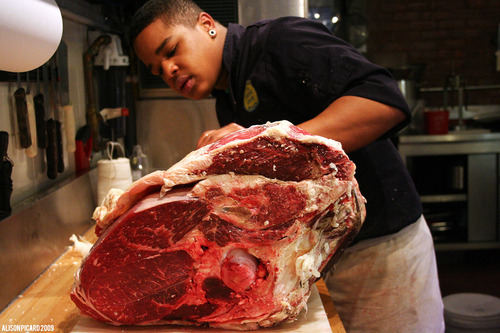
The Ethical Butcher at work

I sat down to the multi-generational table and was overwhelmed by the feeling of just how right this was. Eating feet away from where this food was grown, with the people who put their sweat into making this day happen, I could only hope this experience would become a normal part of this butcher's life. When Ally and I stepped out of the house, the close-to-full moon was shining down on the sleeping farm. We wondered how the animals put themselves to bed as we walked to the car, no longer on watch for the toms. We drove away very slowly, taking it all in. And I just kept repeating, "What a good day".

The butcher at the source

12.8.09

New Digs in the Northwest

I have spent most of the summer relocating to and getting settled in Portland, OR. I am a native Northwesterner who has lived in Portland before, and I know the city well. But like all cities, this is an ever-changing cultural landscape. New restaurants have opened, the "it" neighborhoods of a few years ago have matured and new ones are popping up. I am excited about the possibilities for The Ethical Butcher here in Portland's dynamic food scene. With farms literally at its doorstep, the ocean an hour away and rivers everywhere, Portland naturally lends itself to uninhibited access to sustainable meats and seafood. I am exploring many avenues for getting involved here and already making headway in these first few weeks. Let me fill you in on some of what I'm working on...

  • I will once again be reviewing and listing restaurants and stores that serve or carry meat and fish from sustainable sources. These listings will not be limited to Portland however--Seattle, Tacoma, Olympia and points all over the Pacific Northwest will be included.

  • I recently found a commercial kitchen to begin curing my specialty bacon on a large scale. After navigating the maze of government inspections and licensing, I will finally be able to legally offer custom-curing of both lamb and pork bellies in late September. I had also hoped to sell my bacon at local farmer's markets, but have hit town too late in the season to apply. I will definitely be in markets around the area when the 2010 season begins, just follow the tell-tale smell of bacon cooking...

  • Speaking of my bacon, an update on The Bacon Gospel. Due to some issues with nailing down a supplier, I had to push back the dates a bit. Bacon for the Sound will begin next week and BCN for PDX will take place in September, using some very special local pork. Next March I will be in Austin for SXSW 2010. The Bacon Gospel will look a little different, though. From March 17-21 I will be slinging the most mind-blowing, palate-pleasing BLT's known to man. I've still got one hitch to realizing this vision, though. Due to Texas law, I must set up my stand on private property. If you live, or have lived in Austin, or know anyone who does, I would greatly appreciate leads on businesses in the vicinity of the festival to approach about using their sidewalk. A location on W 6th would be optimal, but I'll take what I can get. I am pretty confident the word will spread...I mean, it is the Gospel, after all.

  • On to one of the most exciting things I've got coming up. I have been developing a pretty fortunate relationship with local farmers who raise one of the rarest breeds of pig in the world, the Red Wattle. Their numbers are so low (around 2000 worldwide) that most of the animals are currently only being used for breeding to get the population to healthy levels. But this is why I used the word "fortunate". I will be using or eating Red Wattle not once, not twice but three times in the next couple of months! I hinted at the special pork I'd be using for BCN for PDX, and Red Wattle is it! Once called the "bacon pig", this pig puts on a superior fat-to-meat ratio. It is an honor to be able to use it for The Bacon Gospel!

  • I also secured a couple of suckling pigs of the same breed from a litter due later this month. I will use them for the first in a series of "farmer/eater meetups" (still thinking of a clever title) at local restaurants this fall and winter. People who attend this event will not only get to eat some of the best pork they've ever had, but meet the tireless farmers who are working so hard to bring heritage breeds back from the brink of extinction. I will do the same with local heritage lamb, goat, rabbit and poultry in the months to come. I am still looking for a location for these events, so if you have ideas, shoot me an email!

  • I must now selfishly admit that I am thrilled for this coming Labor Day weekend. After a slew of emails between myself and the farmers about using their pork for other projects, I was invited to help the farmers pit-roast a 100 lb hog! This is a butcher's and chef's dream! It will be my first time roasting a whole hog and I am beyond ecstatic about eating pork that very few people alive will ever have the occasion to, ON the farm they were raised. I assure you, there will be tons of pictures and and an in-depth interview with these heroes among farmers, butchers, chefs, and pigs. I will also soon write a more informational post about heritage breeds in general, and why it is so very important to buy heritage meats.

  • Lastly, I am working on the beginning stages of a business plan for opening my own shop. This will be a place where, as my name implies, one will be able to buy meat, fish and other animal products from only the most sustainable and trustworthy sources. I am even toying with the idea of offering humane slaughter and processing of chickens and rabbits for all those backyard farmers who are really ready to look their dinner in the face. What is more local than the animals you raise yourself in your own backyard? For many this is a step too far, but if you really think about it...it is a step in the right direction.